


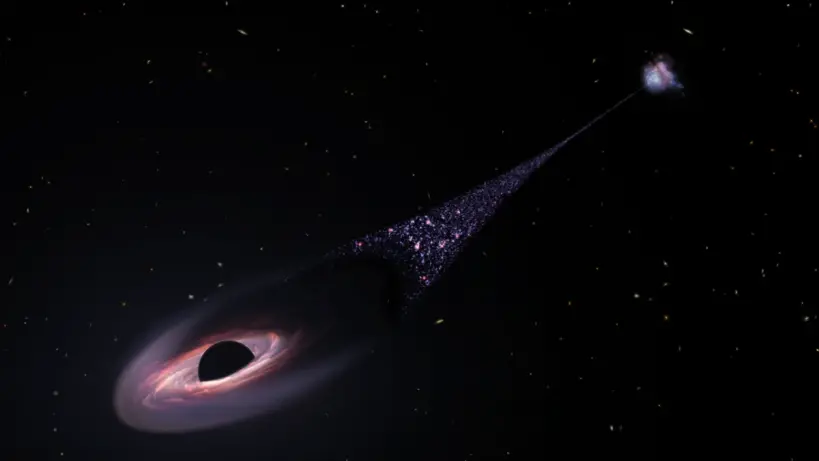
In the infancy of the Universe, some supermassive black holes grew astonishingly large within dense cocoons of gas, much like butterflies in a chrysalis. This intriguing phase of black hole development puzzled astronomers as they sought to understand the mechanisms behind such rapid expansion.
Investigating the Mysterious 'Little Red Dots'
Astronomers using the James Webb Space Telescope (JWST) identified peculiar data points, known as 'Little Red Dots,' which hinted at potential supermassive black holes. If these points truly represented black holes, they would have exhibited masses ranging from 10 to 100 percent of their host galaxies—an extraordinary proportion.
The appearance of these dots at high red shifts indicated their existence when the Universe was about a billion years old. Such massive entities in the early Universe posed questions about how they could grow so quickly without clear explanations.
Unexpected Observations from JWST Data
Astrophysicist Rusakov and his team found these findings particularly curious when analyzing the JWST data. Typically, supermassive black holes emit detectable signals, like X-rays, yet such emissions were absent. The lack of expected X-ray signals added another layer of mystery to the findings.
The Doppler Effect and Spectral Lines
To determine the mass of these black holes, scientists examine the gas orbiting around them. As it spirals towards the black hole, it heats intensely and emits light. This glowing gas moves at incredible speeds, causing a Doppler effect—where light from incoming gas shifts to blue and outgoing gas shifts to red. These shifts result in wide and flat spectral lines with velocities that describe the black hole's mass.
In the case of the 'Little Red Dots,' the spectral lines were notably wide, suggesting extremely high mass estimates. However, the lines showcased an unusual shape, appearing more like a sharp triangle atop broad wings rather than a typical rounded curve.
Understanding these early black holes' growth patterns may unravel secrets of the Universe's evolution and the role of dense gas cocoons in their development.







Comments
Log in to write a comment