


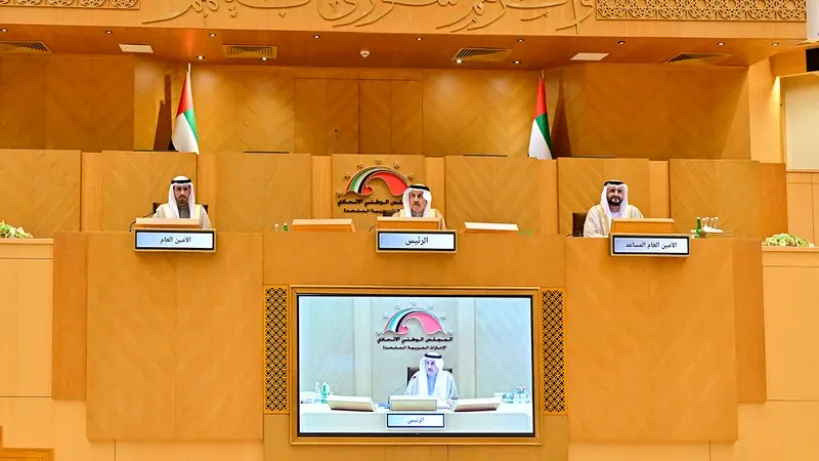
The UAE Federal National Council (FNC), chaired by Saqr Ghobash and attended by Minister of Family Sana bint Mohammed Suhail, discussed the topic of “Family Protection, Its Concept, and Social Role” during its fourth session of the third ordinary convening of the 18th legislative term, held at Zayed Hall in Abu Dhabi.
At the opening of the session, Ghobash stressed that the declaration of 2026 as the “Year of the Family” by His Highness Sheikh Mohamed bin Zayed Al Nahyan reflects a national vision that places the family at the heart of development priorities, recognizing it as the cornerstone of values, identity, and social cohesion. He emphasized that the Council remains a strategic partner to the government in translating this vision into effective legislation and policies.
Following extensive discussions addressing challenges affecting family formation, threats to family security, and the impact of social and economic changes, the Council adopted a set of key recommendations and referred them to the Committee on Social Affairs, Labor, Population, and Human Resources for final drafting.
The deliberations were based on a comprehensive report prepared by the committee, drawing on academic studies, expert interviews, and data provided by several federal entities, including the Ministry of Family, Ministry of Community Empowerment, Ministry of Justice, the Federal Authority for Government Human Resources, and the Federal Authority for Identity, Citizenship, Customs, and Port Security.
Among the أبرز recommendations was amending the executive regulations of Federal Decree-Law No. 23 of 2024 on Social Support and Empowerment to ensure the automatic disbursement of a federal condolence allowance to widows within 10 days of notification of death. The Council also called for establishing a national electronic death notification system and launching a federal platform titled “The Leading Widow” to empower widows and enhance their role in society.
The Council further recommended introducing a unified federal housing framework for widows, establishing a national alimony fund to guarantee immediate payment of court-ordered alimony, and implementing free psychological and social counseling programs for parents after separation to safeguard children’s welfare.
In terms of family protection, members urged stricter measures against domestic violence, including mandatory psychological assessments before reconciliation and banning settlements in repeated abuse cases or when victims are children, elderly individuals, pregnant women, or persons of determination.
Discussions also highlighted the relationship between labor policies and family stability, with calls to expand flexible and remote work options, extend paid maternity leave, support non-working mothers, address housing and marriage challenges facing youth, and ensure balanced family empowerment that includes both women and men as fundamental pillars of the family unit.








Comments
Log in to write a comment